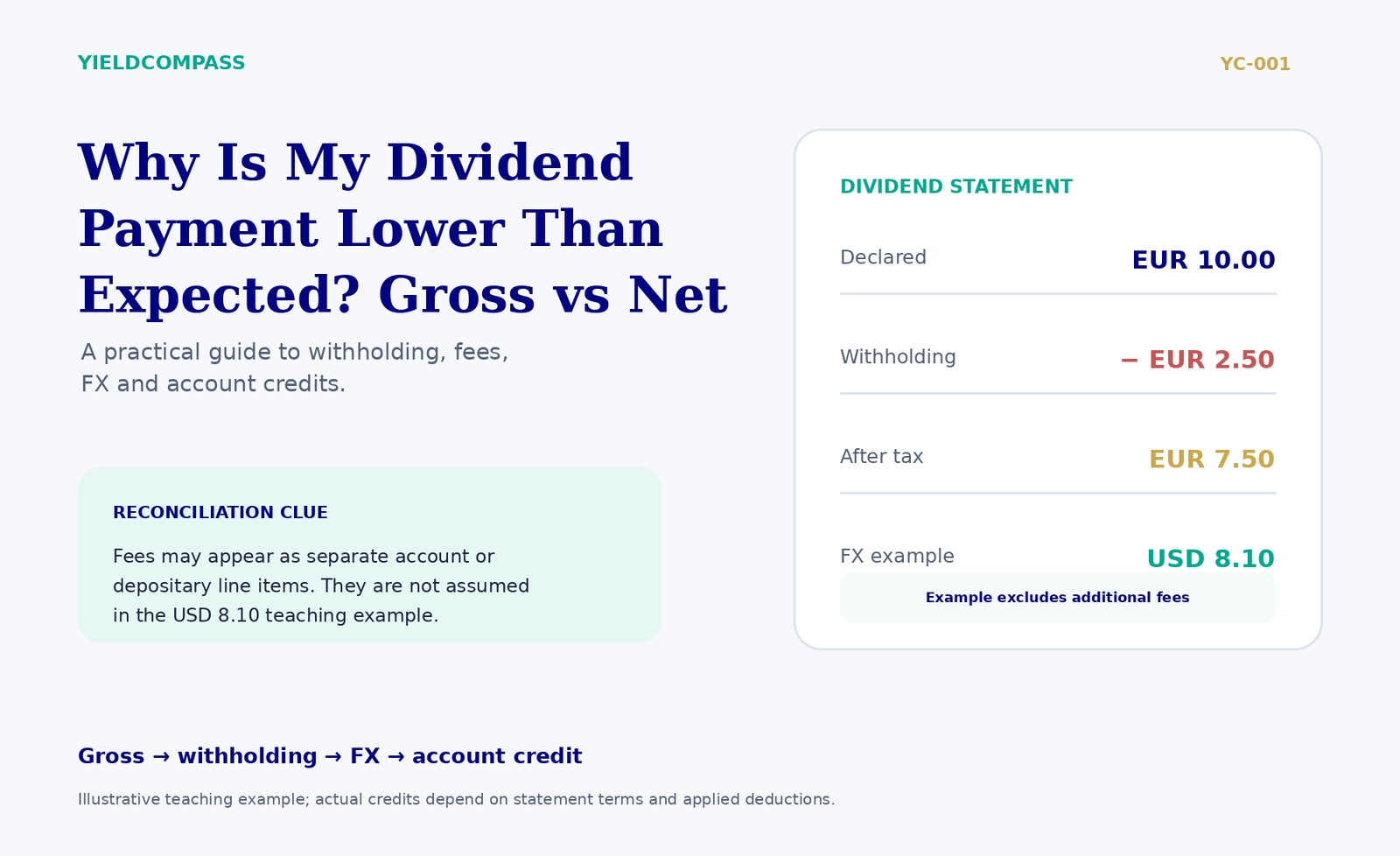
Why Is My Dividend Payment Lower Than Expected? Gross vs Net
The most common reasons are source-country withholding, currency conversion, instrument ratios, eligible share quantity, depositary or account charges, fractional-share treatment, reinvestment elections and processing time. A declared dividend is an issuer amount; it is not automatically the amount credited to an individual account. There is no universal European “net dividend” rate.
This guide shows how to reconcile a dividend from the issuer’s announcement to the amount shown on a broker statement. It is educational information, not tax, legal or investment advice. Tax rates, treaties, broker terms, corporate-action notices and exchange rates change; check the current issuer, tax-authority and account documents for the payment in question.
How to reconcile a dividend payment
- Start with the gross dividend and eligible quantity shown by the issuer or broker.
- Check the withholding rate, relief or reclaim treatment.
- Separate depositary, broker and account charges from tax.
- Compare the currency, FX rate, precision and credit date on the statement.
A continuous hypothetical: from declared dividend to account credit
Suppose an issuer declares EUR 1.00 per share and the eligible quantity is 10 shares. The gross dividend is EUR 10.00. With an assumed 25% withholding, EUR 2.50 is withheld and EUR 7.50 remains. If the account converts that amount at a hypothetical USD 1.08 per EUR 1, the mathematical credit is USD 8.10.
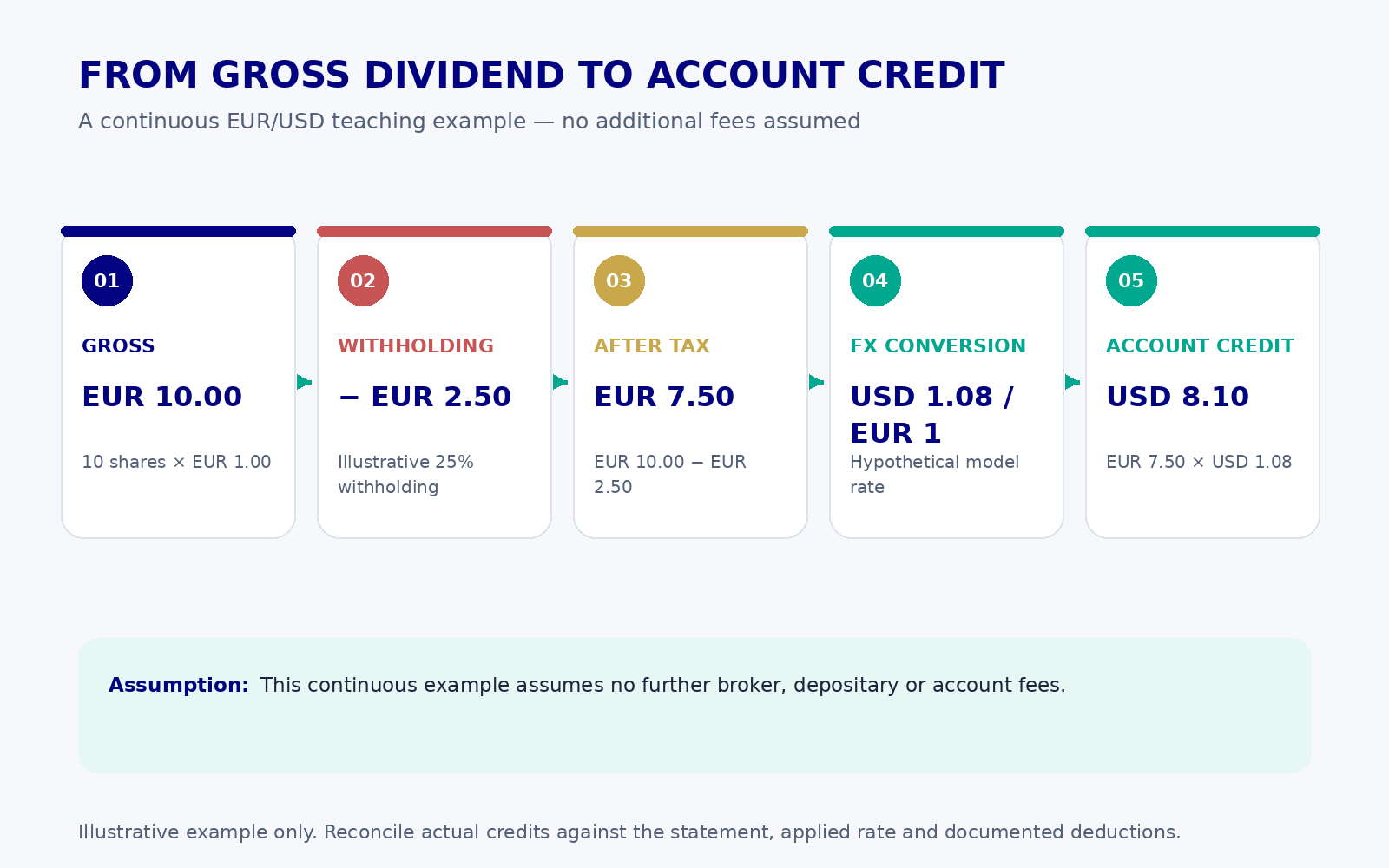
| Statement line | Calculation | Result |
|---|---|---|
| Declared/gross dividend | 10 × EUR 1.00 | EUR 10.00 |
| Illustrative withholding | EUR 10.00 × 25% | −EUR 2.50 |
| Net after that deduction | EUR 10.00 − EUR 2.50 | EUR 7.50 |
| Hypothetical FX credit | EUR 7.50 × USD 1.08 | USD 8.10 |
This is a teaching example, not a prediction. A real reconciliation should use the rate, precision and separately documented fees on the account statement. For a practical record of credits and deductions, see the dividend tracking spreadsheet.
Gross, net, declared and payable: four different labels
Declared is a corporate decision; payable is a cash event
An issuer can announce or propose a dividend before shareholder approval, the record date or the payment date. Nestlé’s 2024 financial statements originally proposed CHF 3.05 per registered share subject to Annual General Meeting approval. Its 158th AGM on 16 April 2025 approved the proposed CHF 3.05 dividend per share. See the Nestlé 2024 financial statements and Nestlé’s AGM release.
“Declared” therefore means the issuer has announced a proposed or approved distribution under the terms in its notice. “Payable” means the issuer’s notice says the distribution is due. Neither the AGM approval date nor the issuer’s payment-from date guarantees the date on which a particular broker credits an account.
Gross is before deductions; net is after a specified deduction set
Gross dividend normally means the stated amount before the deductions identified for the payment. Net dividend means the amount after those stated deductions; it is not necessarily an investor’s final residence-country tax result. A tax return, foreign-tax credit, reclaim, account wrapper and intermediary processing can change the outcome.
Nestlé’s statements show CHF 3.05 gross per share and CHF 1.9825 net after Swiss withholding tax of 35%, with payment from 24 April 2025 if approved. That is an issuer-level calculation, not a statement of every investor’s final tax position.
Example 1 — Nestlé’s approved issuer gross-to-net dividend
The following uses Nestlé’s originally proposed and subsequently AGM-approved CHF 3.05 gross per share, the issuer-stated 35% Swiss withholding and CHF 1.9825 net per share. The quantity is illustrative.
| Step | Calculation | Result |
|---|---|---|
| Gross dividend | 100 shares × CHF 3.05 | CHF 305.00 |
| Withholding shown by the issuer | CHF 305.00 × 35% | CHF 106.75 |
| Net after that withholding | CHF 305.00 − CHF 106.75 | CHF 198.25 |
| Cross-check | 100 shares × CHF 1.9825 | CHF 198.25 |
The issuer’s payment-from date does not guarantee an individual account-credit date. A treaty-eligible foreign resident may have a reclaim route, but eligibility, forms, deadlines and intermediary support are jurisdiction- and instrument-specific. See the Swiss Federal Tax Administration’s reduction-at-source guidance and foreign-residence refund guidance.
Withholding tax: reduction at source, reclaim or credit
The source-country rate and any relief depend on the security, investor residence, beneficial ownership, legal form, documentation and applicable law. A broker’s country of incorporation does not by itself establish the source-country rate.
Three mechanisms commonly appear:
- Relief at source: the payer or intermediary applies a reduced rate when the required documentation is accepted before payment.
- Refund or reclaim: a higher amount is withheld first and an eligible claimant requests an amount back from the source-country authority.
- Residence-country credit or exemption: the investor’s residence-country rules may provide a credit or exemption subject to their own limits.
The U.S. Internal Revenue Service describes 30% or a lower treaty rate for U.S.-source dividends paid to a nonresident alien, while its treaty-benefits guidance explains the role of Form W-8BEN. This is U.S.-specific guidance, not a universal European rate.
Swiss authorities describe a 35% anticipatory tax on investment income and conditional relief or refund routes for eligible foreign residents. The FASTER Directive (EU) 2025/50 sets a future relief-at-source and quick-refund framework within its scope; it does not make every current broker or country process uniform.
Before estimating a reclaim, record tax residence, beneficial ownership, issuer country, instrument, account or wrapper, domestic rate, treaty ceiling, documentation, deadline, fees and any residence-country credit. Do not infer an individual result from the examples in this article.
Brokers, custodians and ADR/depository charges
Use the current terms for the specific account
An intermediary may publish separate terms for trading, FX conversion, corporate-action processing, custody, reinvestment or depositary-receipt services. Whether a charge applies, is passed through or is absorbed is account-, legal-entity-, programme- and date-specific. The current fee schedule and corporate-action notice control a particular account.
Interactive Brokers‘ spot-currency schedule illustrates this boundary: its auto-conversion terms describe a typical 0.03% adjustment for direct clients, at IBKR’s discretion. Its stock commission schedule separately describes minimum-commission treatment. These are broker-specific examples, not market-wide rules.
ADRs and other depositary receipts
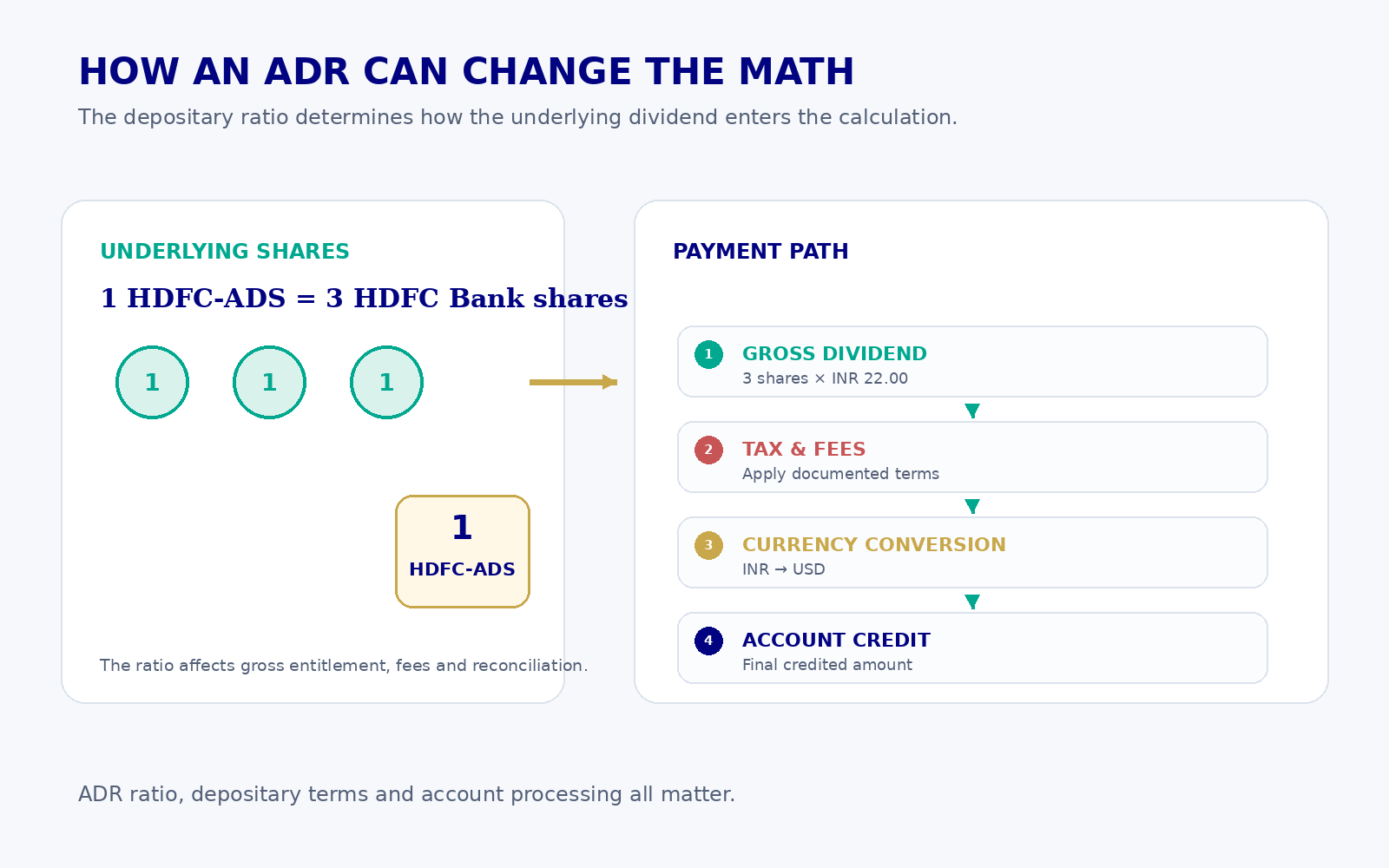
An ADR is not necessarily one ordinary share. The depositary programme determines the ratio, dividend process, currency, charges and timing. The SEC-filed HDFC Bank Form F-6 identifies JPMorgan Chase Bank, N.A. as depositary and states that each ADS represents three HDFC Bank shares. The filing also points to the deposit agreement for distribution procedures and holder fees.
HDFC Bank’s later SEC-filed description of its ADS terms explains that cash dividends are paid after the depositary deducts its charges and expenses, taxes and currency-conversion or transfer expenses. The specific cash-distribution fee modeled below comes from SEC Form F-6, Exhibit 99(a), paragraph (7)(i), which provides for a fee of US$0.05 or less per ADS. This is a maximum for the modeled cash-distribution fee, not proof that every payment is charged at that amount and not a complete schedule of all possible depositary fees.
Example 2 — HDFC ADR dividend reconciliation
This is a transparent maximum-fee scenario using the HDFC programme’s documented ratio and fee ceiling. It is not an account statement and does not assume treaty relief, broker fees or the depositary’s actual conversion quote.
Inputs
- 200 HDFC Bank ADSs/ADRs.
- One ADS represents three underlying HDFC Bank equity shares, as stated in the SEC Form F-6.
- HDFC Bank’s FY2025 dividend was INR 22.00 per underlying equity share, reported in its official dividend history and 2024–25 annual report.
- A 20% Indian withholding assumption, using the Income Tax Department’s current TDS-rate table for dividend income under section 195, with no treaty reduction assumed.
- A hypothetical model rate of INR 95.3129 per USD is used solely to demonstrate the arithmetic. The historical rate is not presented as RBI-verified in this article, and the model rate is not a promise of the depositary’s transaction rate.
- The modeled maximum US$0.05-per-ADS cash-distribution fee under SEC Form F-6, Exhibit 99(a), paragraph (7)(i). This example does not model other possible depositary fees, taxes, currency-conversion or transfer expenses described in the deposit agreement.
| Step | Calculation | Result |
|---|---|---|
| Underlying shares represented | 200 ADSs × 3 | 600 shares |
| Gross INR dividend | 600 × INR 22.00 | INR 13,200.00 |
| Illustrative Indian withholding | INR 13,200.00 × 20% | −INR 2,640.00 |
| INR cash after withholding | INR 13,200.00 − INR 2,640.00 | INR 10,560.00 |
| USD before depositary fee | INR 10,560.00 ÷ 95.3129 | USD 110.792978 |
| Maximum depositary fee | 200 ADSs × USD 0.05 | −USD 10.00 |
| Illustrative net USD payout | USD 110.792978 − USD 10.00 | USD 100.792978 |
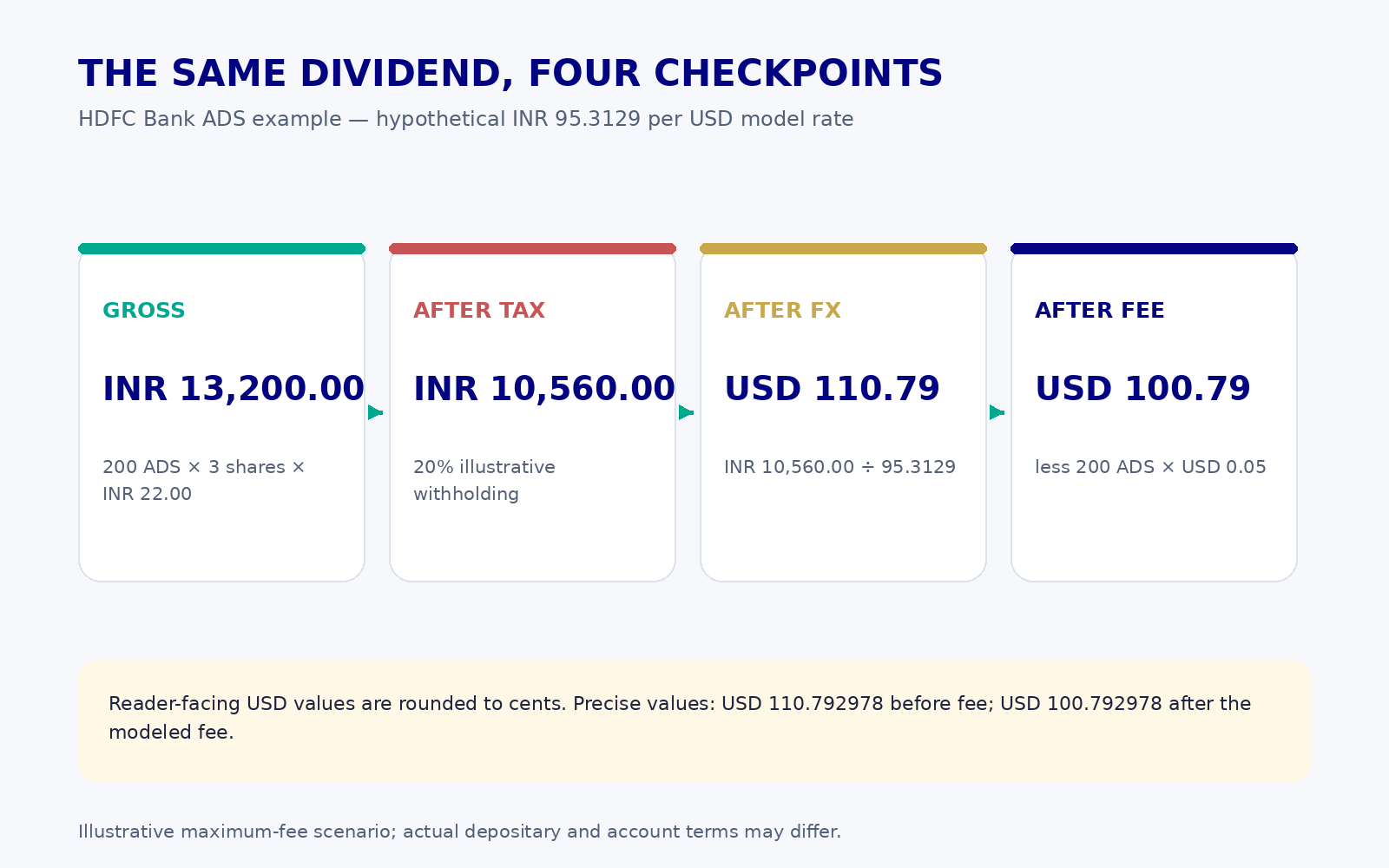
Rounded to cents, the scenario produces USD 100.79. The same fee can be expressed at the reference rate as INR 953.129, leaving INR 9,606.871 after the fee and giving the same unrounded USD result. The actual payment can differ because a treaty may reduce withholding, the depositary may charge less than the stated maximum, the depositary may use a different conversion rate or date, and a broker or custodian may add, absorb or separately show charges. The SEC Form F-6 ratio and the current deposit-agreement terms, not a generic ADR rule, control the instrument.
Currency conversion and FX spread
The currency printed on a dividend notice may differ from the currency credited to an account. The European Central Bank says its euro reference rates are information-only and may not reflect an actual transaction rate. The depositary or broker can use a different rate, timing, spread, commission or rounding method.
Example 3 — illustrative tax and FX comparison
This example assumes 400 shares, a USD 0.80 dividend per share, 30% withholding and a hypothetical 1.5% less-favourable conversion quote. The 30% and 1.5% figures are assumptions. The ECB reference input is EUR 1 = USD 1.1206, dated 9 October 2026.
| Step | Calculation | Result |
|---|---|---|
| Gross dividend | 400 × USD 0.80 | USD 320.00 |
| Illustrative withholding | USD 320.00 × 30% | USD 96.00 |
| Cash after withholding | USD 320.00 − USD 96.00 | USD 224.00 |
| EUR at ECB reference rate | USD 224.00 ÷ 1.1206 | EUR 199.893 displayed |
| EUR at hypothetical 1.5% worse quote | USD 224.00 ÷ (1.1206 × 1.015) | EUR 196.939 displayed |
| Illustrative difference | EUR 199.893 − EUR 196.939 | EUR 2.954 displayed |
The unrounded results are approximately EUR 199.892915 and EUR 196.938832. Applying the IBKR example in the adverse direction uses 1.1206 × 1.0003 and produces about EUR 199.833 before other charges. These are comparison values, not universal bookable amounts; the statement and account terms control.
Share quantity, fractional shares and reinvestment elections
For an ordinary share:
gross dividend = eligible shares × declared dividend per share
For an ADR, first apply the programme’s ratio and dividend terms. For fractional holdings, use the broker’s stated eligible quantity and corporate-action treatment. Do not assume an internal precision or rounding method without a current notice or statement.
With a cash election, applicable deductions are reflected in cash. With a dividend reinvestment plan (DRIP), eligible cash is used to submit a purchase order, subject to the broker’s price, commission, eligibility and fractional-share rules. The official English IBKR DRIP disclosure says that eligible fractional trading can result in whole and fractional shares equal to the dividend less commissions; without fractional trading, IBKR purchases whole shares and credits the remainder as cash, less commissions.
Example 4 — fractional DRIP versus cash
This example assumes no reinvestment commission solely to show the quantity calculation.
| Step | Calculation | Result |
|---|---|---|
| Gross dividend | 12.4 shares × USD 0.80 | USD 9.92 |
| Cash after illustrative 30% withholding | USD 9.92 × (1 − 0.30) | USD 6.944 intermediate |
| DRIP with fractional shares | USD 6.944 ÷ USD 25.00 | 0.27776 shares |
| DRIP without fractional shares | floor(USD 6.944 ÷ USD 25.00) | 0 shares + USD 6.944 intermediate cash |
USD 6.944 is the mathematical intermediate result, not a universal two-decimal booking. A broker may display or book a different precision, commission, execution price or cash remainder.
Ex-dividend, record and payment dates
The declaration date is when the issuer announces the distribution. The record date identifies holders under the issuer’s process. The ex-dividend date is the trading-date rule that determines whether a purchase carries the next dividend; exchange rules and special dividends can change the normal relationship. Investor.gov’s ex-dividend explanation provides the general U.S. framework.
The payment date is when the issuer or depositary says the dividend is payable; it is not necessarily the day an intermediary credits an account. Unilever’s official Q4 2025 announcement lists separate ordinary-share and ADR dates and different listing amounts, demonstrating why the instrument-specific notice controls.
Practical reconciliation checklist
- Instrument: ordinary share, fund unit, ADR or another receipt; confirm ratio and listing.
- Eligibility: quantity under the relevant ex-date and record-date process, including fractional quantity.
- Declared amount: currency, per-share or per-DR amount, and proposal or approval status.
- Gross entitlement: eligible quantity multiplied by the applicable amount.
- Source withholding: rate actually applied and whether treaty documentation was accepted.
- Relief or reclaim: amount recoverable, deadline, fees and evidence.
- Intermediary/depositary: current corporate-action, custody, ADR and reinvestment terms.
- Currency: payment currency, conversion date, credited rate, spread/commission and precision.
- Election: cash or reinvestment; for DRIP, execution price, fractional support and residual cash.
- Residence-country treatment: reporting, credit, exemption or additional tax under the investor’s rules.
If the account credit differs from the estimate, compare each documented line item instead of treating the difference as unexplained tax. Fixed charges and rounding can matter especially for small positions.
Jurisdiction and instrument caveats
- Investor residence: treaty benefits and residence-country taxation are personal facts.
- Account type: wrappers and domestic paying-agent rules can change reporting and withholding treatment. The German Federal Ministry of Finance’s tax guide is general information, not individualized advice.
- Instrument: ordinary shares, funds, ADRs and other receipts can have different ratios, currencies, dates and terms.
- Broker/custodian: fees and corporate-action practices change; obtain the terms for the legal entity holding the account.
- Time sensitivity: dated sources are evidence captured at a point in time, not a promise that later rates or terms remain unchanged.
How to Reduce Dividend Withholding Taxes, FX Costs and Unnecessary Fees
Once you have reconciled the statement, the next question is whether a deduction can be prevented or recovered—and whether the likely benefit justifies the effort. A refund is not automatically a permanent increase in after-tax income. The guidance below is general education, not individual tax advice; treaty access, reclaimability, German tax treatment and broker procedures depend on the investor, account, security and payment.
What can be reduced before payment?
First check whether the source country permits treaty relief at source for your residence country and whether your broker or custodian supports it. Where available, submit the required tax-residence and beneficial-owner forms before the issuer’s deadline; for example, some U.S. dividends may qualify for a reduced withholding rate when valid treaty documentation is on file. This is not universal: a broker may pass on the statutory rate and leave any treaty relief to a later reclaim. Confirm the rate and paperwork with the broker for the specific security and account type.
Also verify that the account’s registered tax residence and legal ownership details are current, and that the shares are held in an account eligible for treaty benefits. A tax-advantaged wrapper, nominee structure, lending arrangement or missing documentation can change the process. Do not assume that a broker’s displayed “tax rate” is the final treaty rate.
What may be reclaimed after payment?
If the source country withheld more than the applicable treaty permits, the excess may be reclaimable from that country, subject to eligibility, beneficial ownership, proof of tax withheld, deadlines and the authority’s procedure. A refund of source-country tax is not automatically a final net gain: the dividend may still be taxable in the investor’s country of residence, and reclaim fees, FX movements and processing time reduce the economic value.
Illustrative Nestlé scenario — German tax resident. Assume an individual is resident for tax purposes in Germany, is the beneficial owner of the shares, qualifies for the Switzerland–Germany tax treaty, and receives a CHF 3.05 dividend on each of 100 Nestlé shares. The gross dividend is CHF 305. This is a model based on the stated per-share amount, not a forecast or a claim about a current payment.
On a phone: Swipe or scroll horizontally to see all columns.
| Calculation | Rate / basis | CHF |
|---|---|---|
| Gross dividend | 100 × CHF 3.05 | 305.00 |
| Swiss withholding initially deducted | 35% | −106.75 |
| Potential Swiss refund in this treaty scenario | 20 percentage points of gross | +61.00 |
| Swiss tax remaining after the modeled refund | 15% | −45.75 |
| Cash after Swiss tax/refund, before German tax, fees and FX | 305.00 − 45.75 | 259.25 |
The 35% initial Swiss withholding and the 15% treaty ceiling for an eligible individual imply a potential 20-percentage-point refund here. The CHF 61 is a potential refund of Swiss withholding, not a promise and not the investor’s final net benefit. The treaty entitlement and the facts must be confirmed for the actual payment.
For Swiss dividends due from 1 January 2020, the Swiss Federal Tax Administration (FTA/ESTV) directs German-resident applicants to submit the German F85 application online through its ePortal. The FTA’s current user guide says the generated stamp sheet must be signed and certified by the responsible German Finanzamt, then uploaded to the application before it is validly submitted. Attach evidence for each claim, such as the broker’s corporate-action statement or bank tax voucher showing the payment credited in the applicant’s name and the Swiss withholding rate and amount. Retain the dividend notice, account statement, security/holding evidence and correspondence. Follow the live ePortal instructions and deadline; the ESTV states a general three-year forfeiture period after the end of the calendar year in which the taxable payment fell due, subject to the governing rules and exceptions.
German tax is separate. Germany may tax the dividend under its domestic rules. For an eligible taxpayer using the investment-income regime, EStG §32d(5) provides for a credit of qualifying foreign tax paid, reduced by an existing relief/refund entitlement, and capped by the German tax attributable to the foreign income. The Swiss refund and German credit therefore must not be counted twice: the modeled CHF 61 is not tax finally borne. Whether and how the remaining Swiss tax is creditable in the individual return depends on the applicable treaty, German law, account/bank reporting, other tax factors and the Finanzamt’s assessment. Check the tax certificate and consult a German tax adviser for the specific return; do not treat the arithmetic above as a German tax calculation.
Potential refund versus assumed procedure cost. The table assumes CHF 3.05 gross per share and the same treaty-eligible German-resident beneficial owner in each row. The CHF 40 is a freely chosen, fixed model assumption per claim—not an official ESTV charge, quote, or per-share cost. The difference is simply modeled potential refund less CHF 40; it is not an expected or guaranteed final after-tax benefit.
On a phone: Swipe or scroll horizontally to see all columns.
| Nestlé shares | Potential Swiss refund | Assumed procedure costs | Difference before German tax, FX and time |
|---|---|---|---|
| 100 | CHF 61 | CHF 40 | CHF 21 |
| 500 | CHF 305 | CHF 40 | CHF 265 |
| 1,000 | CHF 610 | CHF 40 | CHF 570 |
At 100 shares, the modeled margin is only CHF 21 before German tax, FX, time and any additional costs not included in the CHF 40 assumption. Those factors could erase it. Larger modeled holdings leave a wider pre-tax margin under this fixed-cost assumption, but the table still does not establish an individual net benefit. Use it to decide whether to investigate your own documents and costs—not to assume a refund.
Broker, FX and ADR costs worth checking
- Broker and custody fees: Compare the exact tariff for foreign-currency dividend processing, custody, minimum charges and corporate actions. Ask whether an announced fee is issuer-, custodian- or broker-imposed and whether it is avoidable by changing the service or account. Do not switch solely on a headline price; include transfer costs, tax-lot records, market access and service quality.
- FX conversion: Check the credited exchange rate, conversion timestamp, spread and any fixed/minimum charge on the statement. Compare the broker’s disclosed rate with a suitable contemporaneous reference rate, allowing for timing and market spread. If the broker permits holding the dividend currency or converting manually, compare the all-in cost, minimums and operational risks before changing the setting.
- ADRs/depositary receipts: Read the current deposit agreement and fee schedule. A depositary may deduct a program fee from a distribution; the broker may add separate charges. If an economically equivalent ordinary share or listing is available, compare total trading, custody, conversion and tax costs, liquidity and access before choosing. The instruments are not automatically interchangeable.
- Tax documentation: Keep residence and beneficial-owner records current, and submit treaty-relief forms in time where the broker supports relief at source. Confirm the outcome on a later dividend advice rather than assuming the form was accepted.
When a reclaim may not be worth pursuing
Estimate the net expected recovery, not the gross refund: probability of approval × expected refundable amount − broker/agent/certificate/postage/translation costs − FX cost − value of time and delayed cash. It may be uneconomic when the recoverable amount is small, fees are fixed or high, records are missing, the investor’s entitlement is uncertain, the claim is near a deadline, or the German tax credit/return treatment offsets some or all of the apparent gain. The FTA’s German application process itself is described as free; third-party assistance and the investor’s own documentation or tax-advice costs may not be. Compare the expected net value with the effort, and never let a small claim cause a larger tax-filing error.
Investor Action Checklist
On a phone: Swipe or scroll horizontally to see all columns.
| Problem | Possible optimisation | Expected benefit | Documents needed | Next action |
|---|---|---|---|---|
| More tax withheld at source than expected | Check treaty relief at source and valid residence/beneficial-owner documentation | Potentially less cash withheld initially; eligibility and broker support vary | Tax-residence certificate, broker tax forms, account ownership details | Ask the broker which rate and forms apply to this exact security/account before the next ex-date |
| Swiss dividend withheld at 35% | For eligible German residents, assess reclaim of the amount above treaty-allowed 15% | Illustration: up to CHF 61 on CHF 305 gross, before German tax and costs; not guaranteed | ESTV ePortal/F85 data, corporate-action statement or tax voucher, holding/account proof, certified stamp sheet | Check eligibility and claim deadline; register in ESTV ePortal and follow the current F85 instructions |
| German return may include foreign dividend tax | Reconcile foreign tax paid after any refund entitlement; claim only allowable credit | May reduce German tax, subject to statutory and treaty limits; not an extra refund guarantee | Annual tax certificate, dividend advices, Swiss refund decision/payment evidence | Provide final net foreign tax evidence to the tax preparer/Finanzamt and ask how §32d(5) applies |
| Unexpected currency deduction or poor FX rate | Compare all-in spread/fees; consider holding currency or alternative conversion if supported | Potentially lower recurring conversion cost; depends on amounts and tariffs | Dividend advice, cash ledger, broker tariff, timestamped reference rate | Recalculate one actual payment and compare alternatives before changing settings |
| ADR/depositary fee appears on statement | Verify the fee against current deposit terms; compare eligible alternative listings | Possibly avoidable cost; security, liquidity and tax differences may outweigh it | ADR fee notice/deposit agreement, broker statement, alternative instrument tariffs | Ask broker/depositary to identify the charge and compare total cost before trading |
| Claim effort exceeds likely recovery | Use a conservative net-value estimate; skip or consolidate only where rules permit | Avoids spending more than the likely after-tax recovery | Estimated reclaim, fee schedule, records availability, tax position | Calculate expected net recovery and check deadlines before paying an agent |
Bottom line: confirm treaty relief before payment, reconcile the actual statement, reclaim only tax that is both eligible and economically worthwhile, and account for residence-country tax before calling a refund a saving.
Official sources: Swiss FTA: Germany — F85 online application and user guide; Swiss FTA ePortal services; Swiss FTA: refund limitation periods; Swiss FTA: treaty withholding-tax documents, current from 1 January 2026; German Income Tax Act (EStG), §32d(5); Nestlé: 2025 AGM release (CHF 3.05/share approval).
Conclusion: model the cash flow, then verify the statement
Explain the difference by reconciling the declared dividend, eligible shares, withholding, fees, conversion and payment timing against the actual statement. Then identify which deductions are unavoidable, which might be reduced at source, and whether any excess tax could be reclaimed.
Optimize only after checking the rules and the numbers for your own account: confirm treaty paperwork with the broker, compare the actual all-in FX and instrument costs, and weigh a possible refund against procedure costs, residence-country tax and time. The Nestlé figures are a model, not a promise; keep the issuer notice, tax voucher and account statement, and seek individual tax advice where needed.
FAQ
Was the Nestlé dividend approved, and when should it reach my account?
Nestlé’s 2024 financial statements originally proposed CHF 3.05 gross per share. Its 158th AGM on 16 April 2025 approved the proposed CHF 3.05 dividend per share, and the issuer’s financial statements stated payment from 24 April 2025. Those are issuer-level approval and payment-from facts, not a guaranteed date for an individual broker-account credit.
Is withholding tax always 20%, 30% or 35%?
No. The HDFC example uses a stated Indian 20% assumption for a transparent calculation; the IRS example is U.S.-specific, and Swiss authorities describe a Swiss rate and conditional relief. Other source countries and investor facts can produce different results.
Can I reclaim foreign dividend withholding tax?
Sometimes. It depends on law, treaty entitlement, beneficial ownership, documentation, deadlines and the intermediary route.
Can an ADR dividend differ from an ordinary-share dividend?
Yes. The ADR ratio, programme terms, currency, withholding and documented depositary charges can change the result. For HDFC Bank, the SEC Form F-6 states that one ADS represents three underlying shares; the programme terms control the distribution.
Does dividend reinvestment always create a fractional share?
No. IBKR’s English disclosure gives conditional treatment, and other brokers can use different rules.
Which exchange rate should I use?
Use the rate applied at the actual conversion event for reconciliation. Central-bank reference rates are comparison inputs and may not equal the credited transaction rate.
Sources
The following official or primary sources support the factual claims and examples. Rates, notices and procedures can change; check the current source and the applicable account or instrument terms.
- SEC / Investor.gov — Ex-Dividend Dates
- Nestlé S.A. — 2024 financial statements
- Nestlé S.A. — 158th AGM release
- Unilever PLC — Q4 and FY2025 announcement
- U.S. Internal Revenue Service — U.S.-source income withholding
- U.S. Internal Revenue Service — Claiming tax-treaty benefits
- Swiss Federal Tax Administration — Reduction at source
- Swiss Federal Tax Administration — Refund for residence abroad
- European Union — Council Directive (EU) 2025/50
- European Central Bank — Euro foreign-exchange reference rates
- Interactive Brokers — Spot-currency commissions
- Interactive Brokers — Stock commissions
- Interactive Brokers — Automatic Dividend Reinvestment Disclosure, Form 9611 (English)
- U.S. SEC — HDFC Bank Form F-6 post-effective amendment
- U.S. SEC — HDFC Bank Form F-6, Exhibit 99(a), Deposit Agreement, paragraph (7)(i)
- U.S. SEC — HDFC Bank ADS terms, Exhibit 2.3
- HDFC Bank — Official dividend history
- HDFC Bank — Integrated Annual Report 2024–25
- Income Tax Department of India — TDS rates
- German Federal Ministry of Finance — An ABC of Taxes